

teaching and training
hku-mit summer institute
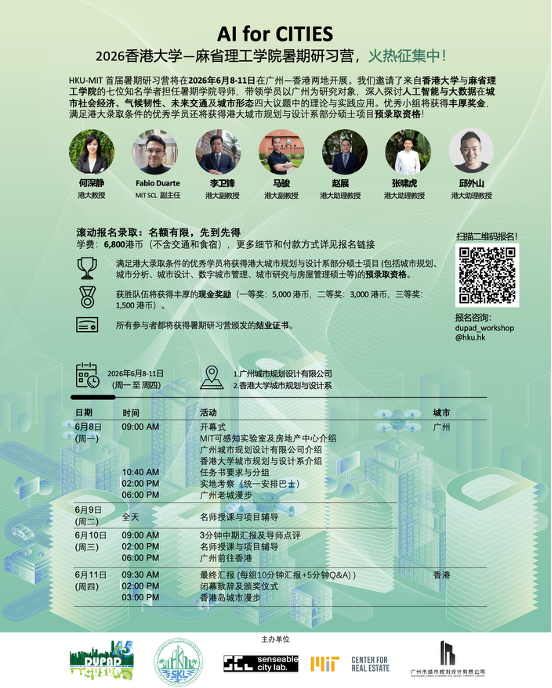
The HKU-MIT Summer Institute was established in 2026 by DUPAD and the State Key Laboratory of Subtropical Building and Urban Science, Hong Kong Base. The inaugural event will be held from June 8 to 11, 2026, in collaboration with the MIT Senseable City Lab, the MIT Center for Real Estate, and Guangzhou Urban Planning and Design Co., Ltd., with activities taking place in both Hong Kong and Guangzhou. Themed ” AI for Cities “, we will weave together humanity, nature, technology, and urban society into a dynamic, intelligent ecosystem through the application of LLMs, GenAI, big data, spatial analysis, and sensor technologies, and advocate for precise, efficient, and sustainable urban development pathways. We will explore pressing urban challenges in Guangzhou under four topics: socio-economics, environmental resilience, future mobility, and urban morphology. In an era of rapid AI advancement, we will investigate the transformative intersection of digital technologies, intelligent algorithms, and urban research—uncovering AI’s potential to empower urban planning and design while driving a paradigm shift in urban systems and methodologies.
Through the application of large language models, generative AI, big data, spatial analysis, and sensor technologies, we advocate for precise, efficient, equitable, and sustainable urban development pathways, freely exploring the four major themes of “Socio-Economics, Environmental Resilience, Future Mobility, and Urban morphology”.

1. Social economics
This theme focuses on the critical role of social infrastructure (social housing, healthcare, and education) in promoting social equity and wellbeing. By examining urban redevelopment, housing price mechanisms, urban-rural migration, and informal housing, we will explore the impact of social infrastructure on residents’ economic opportunities, social mobility, and urban governance. Integrating the application of smart technologies, this theme investigates how to optimize resource allocation and policymaking for enhancing social infrastructure, advocating for precise, efficient, and sustainable pathways for urban socio-economic development. It aims to provide innovative solutions for building a more inclusive and equitable urban future.

2. environmental resilience
You will explore AI- and Big Data-Driven Climate-Resilient Urban Planning, focusing on leveraging these technologies to address urban climate resilience challenges. Participants will learn to use remote sensing technologies and urban modeling tools to analyze urban layout, air pollution, and environmental factors, including the urban heat island effect. The course emphasizes datadriven strategies for sustainable land-use planning, air quality improvement, and climate risk reduction. Through case studies and hands-on exercises, participants will gain the skills to support AI-driven decision-making, fostering climate resilience and sustainable urban development.
Meanwhile, you will learn about Intelligent Environmental Sensing, which delves into how advanced sensing technologies and artificial intelligence can monitor and optimize urban environments. Participants will learn to use drones, LiDAR, and social sensing technologies to analyze air quality, urban waste management, and green energy systems. The course emphasizes integrating sensing technologies with AI to develop real-time, data-driven solutions for challenges such as the urban heat island effect and resource optimization. Through practical applications, the course demonstrates how to build smarter, more sustainable urban systems.
3. future mobility
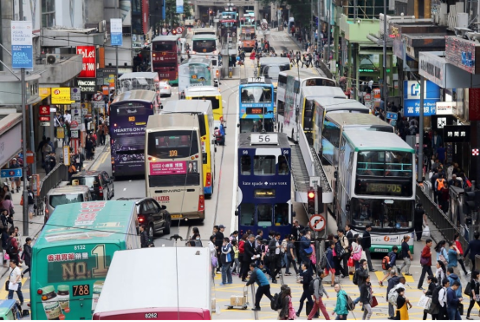
AI-Optimized Shared Mobility: You will explore how AI and Data-Driven Solutions can optimize shared mobility systems, including ride-hailing, carsharing, and e-scooters, to enhance urban transportation efficiency. Participants will learn through AI-driven simulations and data analysis to understand the relationship between shared mobility services, land use, and sustainability. By combining case studies, the course analyzes emerging mobility trends and their impact on urban systems, providing participants with practical tools and insights to design efficient, environmentally friendly modern urban transportation solutions.
Spatiotemporal Data Mining: You will advance using spatiotemporal data mining and machine learning to analyze human mobility patterns and urban dynamics. Participants will learn to use AI tools to design adaptive mobility solutions that optimize the management of public transit and shared mobility systems. The course highlights practical applications of AI to alleviate traffic congestion, improve urban accessibility, and enhance transportation systems. By combining advanced data analytics with real-world case studies, the course equips participants with the skills to build smarter, more efficient urban transportation networks.
4. urban morphology optimization
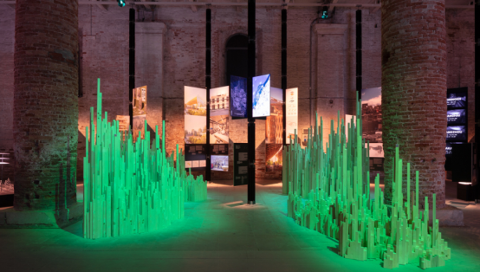
Generative AI for Human-Centric Urban Design: You will explore how generative artificial intelligence can reshape urban design to create more human-centered urban environments. Participants will learn to use AI tools to analyze urban spaces, optimize pedestrian experiences, and enhance the inclusivity of public spaces. Through case studies and hands-on activities, the course demonstrates how AI-driven design processes can improve public spaces, promote social equity, and advance sustainability. The course also explores innovative methods for integrating generative design with urban data to provide responsive solutions for diverse community needs.
Smart Eyes of the Street: You will examine how generative artificial intelligence and computer vision technologies can analyze and optimize urban public spaces. Participants will learn to use generative adversarial networks (GANs) and diffusion models to generate scarce urban scene data, employ computer vision tools such as YOLO and SAM for real-time analysis of urban public life, and utilize LLMs to simulate citizen perspectives for iterative, inclusive design processes. The course demonstrates how AI-driven real-time feedback can improve urban design, creating more livable, human-centered urban spaces.
Our partners
MIT Senseable City Lab (SCL)
The MIT Senseable City Lab is a research laboratory within the Department of Urban Studies and Planning (DUSP), which, in turn, is part of the MIT School of Architecture and Planning (SA+P). The lab aims to investigate and anticipate how digital technologies are changing the way people live and their implications for the built environment. Its mission statement says that it seeks to creatively intervene and investigate the interface between people, technologies, and the city. The Lab's work draws on diverse fields such as urban planning, architecture, design, engineering, computer science, natural science, and economics to capture the multi-disciplinary nature of urban problems and deliver research and applications that empower citizens to make choices to make a better livable urban experience.
MIT Center for Real Estate (CRE)
MIT Center for Real Estate investigates the real estate practice and transaction from initial concept to market realization. We provide breakthrough knowledge for organizations to capitalize on today’s dynamic markets and technologies. Paired with the MITs tradition of excellence in technology, knowledge transfer, and global reach, CRE’s research and education initiatives help train practitioners to build responsibly and profitably.
Guangzhou Urban Planning and Design Co. Ltd. (GZUPDC)
Guangzhou Urban Planning and Design Co. Ltd., established in 1992, is a state-owned enterprise supervised by the Guangzhou Municipal Bureau of Planning and Natural Resources and a renowned think tank for urban planning consultancy in China. The company is dedicated to building a digital-intelligent planning consultancy think tank platform, further extending the industrial chain of the planning sector. Its services include policy research, industrial planning, land value operations, real estate planning and consultancy, planning publicity, and architectural design consultancy. The company provides full-cycle, intensive, and integrated technical consultancy services, ranging from specialized pre-planning research to construction and operation.